
Results come from execution, not slides.
We run campaigns across OTW360 and ULYNQ with one rule: the work must be visible, trackable, and improvable. Below is the exact structure we use to plan, execute, and report campaigns.
What you’ll receive: an objective-led route + execution log + response signals (scans, chats, redemptions, submissions).
Campaign library (ready-to-run routes)
These are the three most common routes we build because they convert in the real world: local visibility, structured participation, and hybrid recall + action.
Route 01 — OTW360 Launch Burst (Neighbourhood Takeover)
Best when you need fast awareness + enquiries in a specific area.
Execution
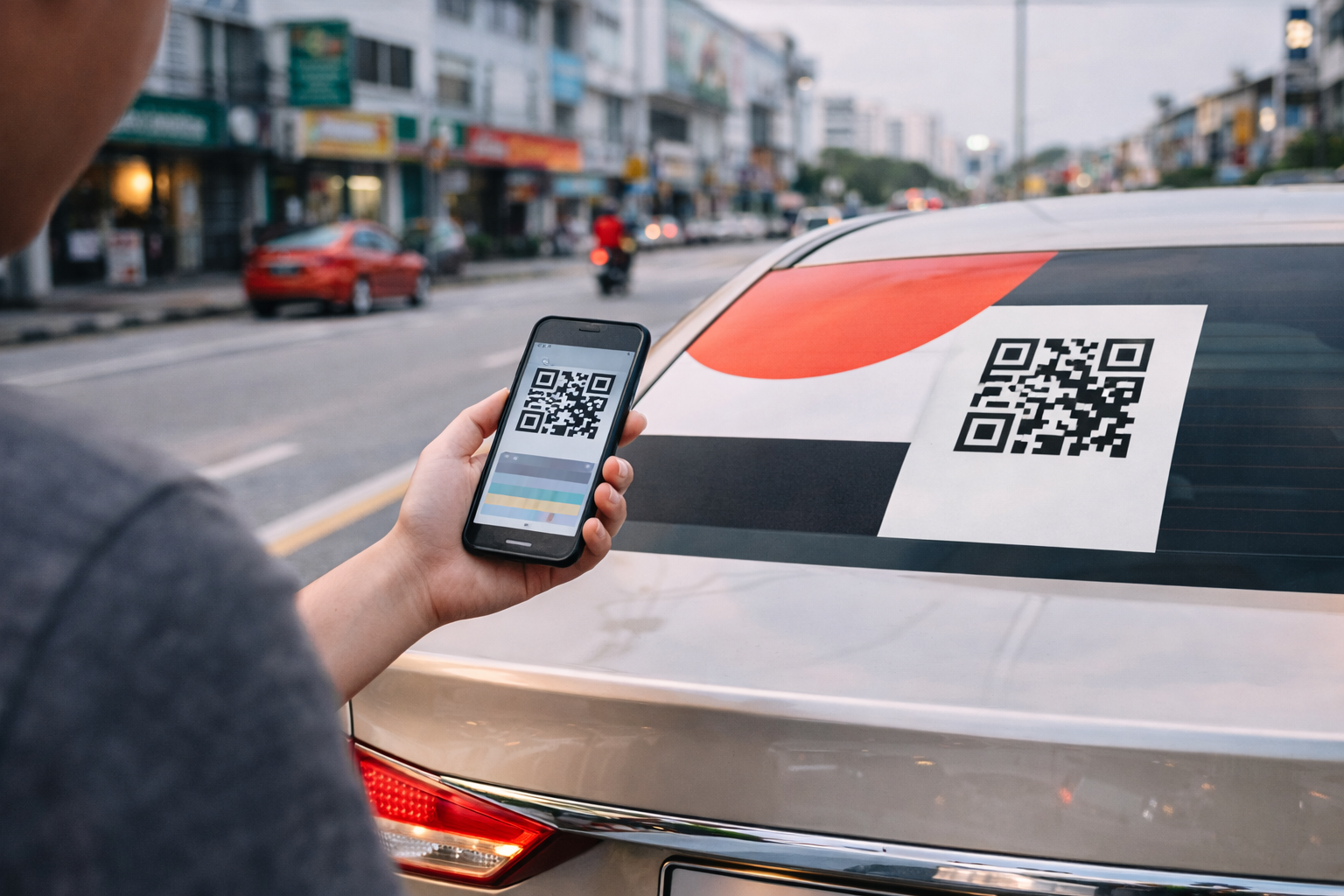
- Placement: rear + mixed for traffic-jam visibility and repeat exposure.
- Area focus: 2–3 neighbourhood clusters + commuter corridors.
- Duration: 4-week burst to build recall fast.
- CTA path: QR-to-WhatsApp voucher (fastest Malaysian enquiry behaviour).
Selling angle: you don’t “run ads”. You occupy the area until people assume your brand is the default.
Signals reported
- QR scans by week + which clusters produced the most scans.
- WhatsApp chats started + common questions (lead quality indicator).
- Voucher claims / code usage (if included).
Optimisation levers
- One offer, one message, one QR path (reduce hesitation).
- Cluster-first beats city-wide when the goal is enquiries.
- Reply speed on WhatsApp affects ROI more than “creative”.
Route 02 — ULYNQ Trial Engine (Redemption + Feedback Loop)
Best when you want adoption proof, not just reach.
Execution
- Program: limited redemption windows by campus (clean tracking).
- Mission: redeem → confirm → optional short feedback/submission.
- Optional creator task: students produce campus-native content.
- Scale rule: expand campuses that show strongest completion rate.
Selling angle: this route creates usage proof you can show internally—participation logs and redemption records.
Signals reported
- Redemptions by campus + time window (behaviour pattern).
- Completion rate (how “easy” the mechanic felt).
- Submissions/feedback volume (if included).
Optimisation levers
- Make the mission one-step if volume matters.
- Time windows matter (class schedule beats guesswork).
- Perk size matters less than frictionless redemption.
Route 03 — Hybrid Conversion Route (Recall → Participation)
Best when you need both familiarity and action signals.
Execution
- Phase 1: OTW360 runs in target areas to build familiarity.
- Phase 2: ULYNQ mission triggers sign-up / submission / trial.
- CTA path: QR-to-WhatsApp for fast questions + landing page for details.
- Iteration: shift budget to zones/campuses with stronger signals.
Selling angle: OTW360 makes you seen repeatedly; ULYNQ makes you measurable.
Signals reported
- QR scans + WhatsApp chats (intent and objections).
- Mission completions (sign-ups/submissions).
- Drop-off points (where conversion friction occurs).
Optimisation levers
- Reduce steps, reduce fields, reduce decision time.
- FAQ via WhatsApp turns hesitation into conversion (Malaysia reality).
- Focus beats “more reach” when the goal is enquiries.
Want a route built for your category?
Send your goal + location focus. We’ll propose a route and define the exact response signals to track.